Loading…
·1 min read
Ambiente Just Evolved: More Control, More Efficiency, Same Philosophy
Ambiente Update 1.4
We’ve just released a major update to Ambiente, and if you only look at the surface—new names, new images, new rooms—you’re missing the point.
This isn’t a cosmetic update.
It’s a structural one.
First: Performance Matters (And It’s Now Better)
Let’s start with the obvious: Ambiente is now significantly more efficient.
- Lower CPU usage
- Better overall performance
- More headroom in complex sessions
This alone changes how you can use it. You’re no longer negotiating with your system—you’re working with it.
But performance is not the core story.
The Real Shift: A More Coherent System
Ambiente has always been different from traditional reverbs.
This update makes that difference clearer—and more usable.
Most reverbs, especially convolution-based ones, rely on static presets. You pick a room, and that’s it. The sound is fixed.
Ambiente doesn’t work like that.
It never did.
Ambiente is a modeled environment.
That means:
- Rooms are not recordings
- Rooms are not fixed
- Rooms are generated based on parameters
And those parameters matter more than any name or image.
Rooms Are Not Presets. They’re Configurations.
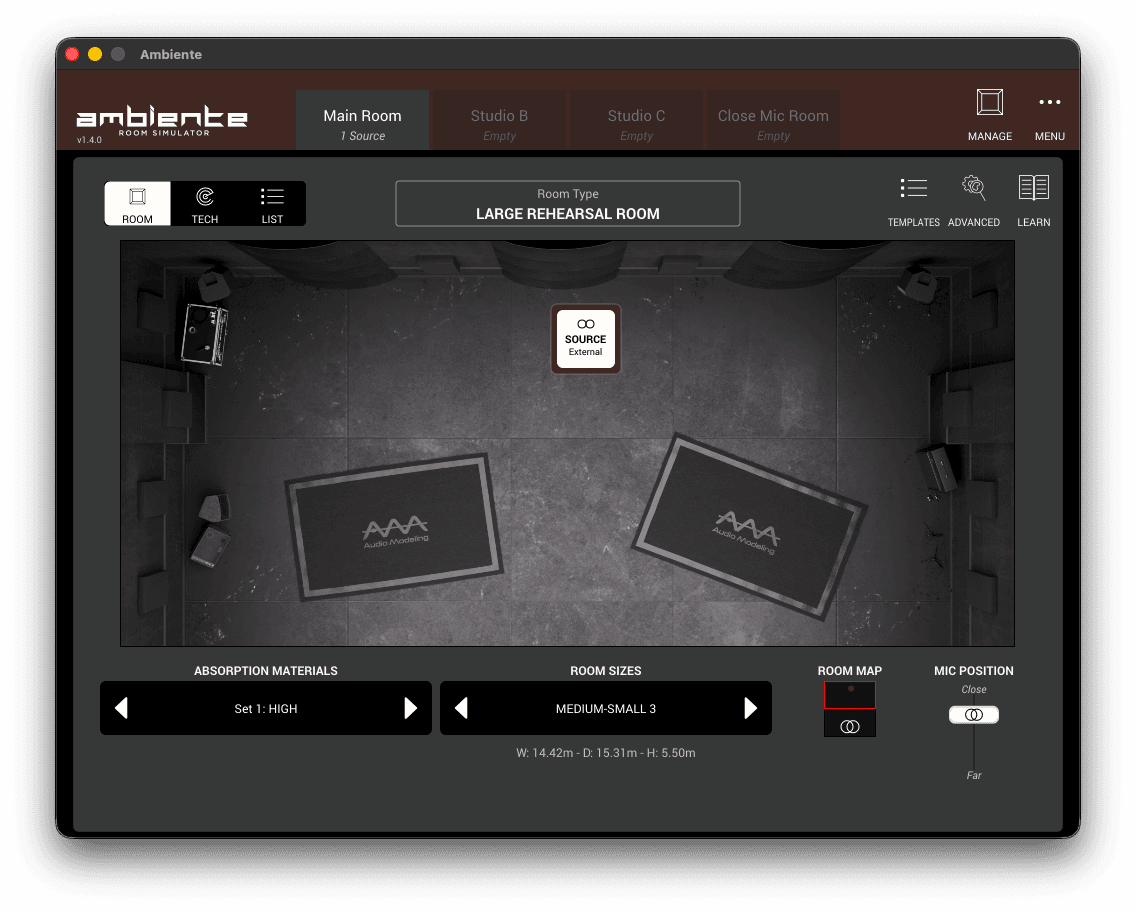
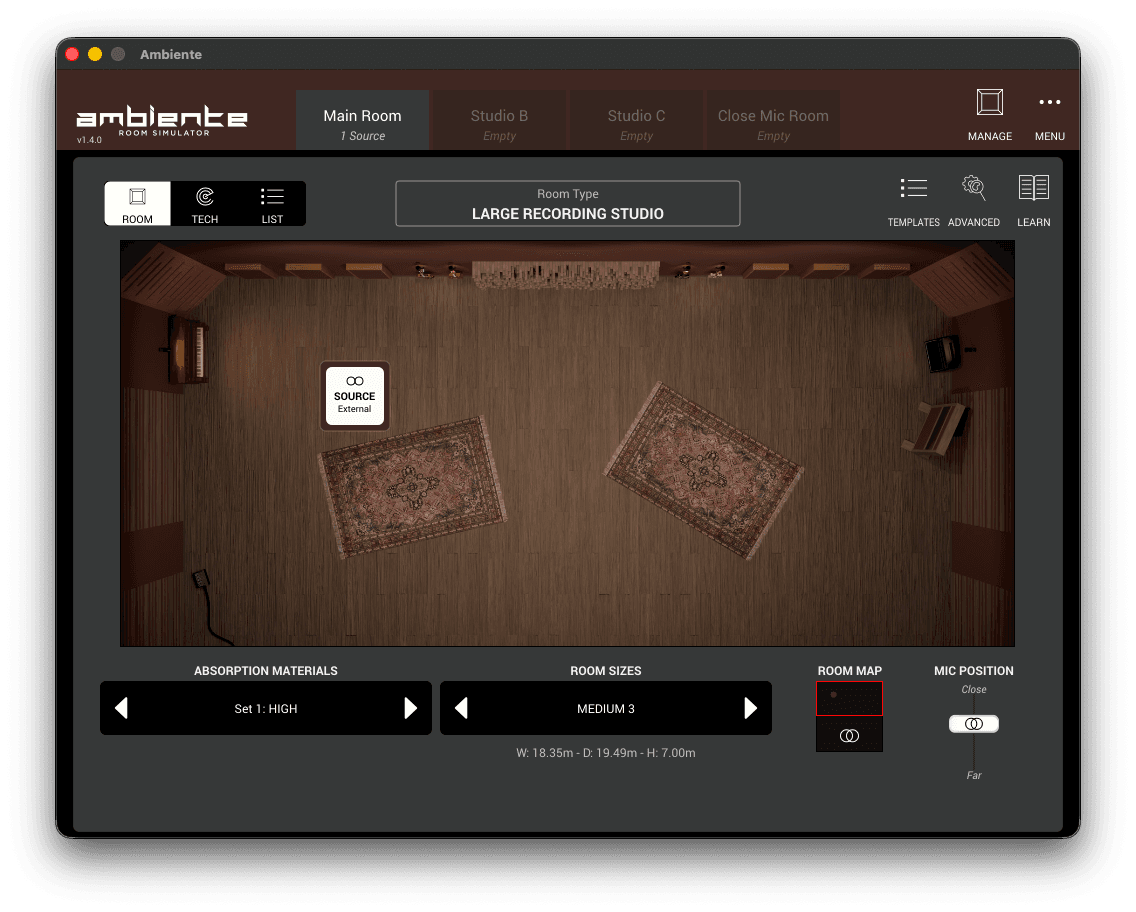
In this new version, we’ve reorganized the room system to reflect what actually defines a space:
- Size (geometry)
- Absorption (how reflective or damped the space is)
Every room now exists as a combination of these two dimensions.
We’ve also introduced three absorption levels per room, giving you immediate control over how “live” or “controlled” a space feels:
- Low absorption → more reflections, more energy
- Medium absorption → balanced response
- High absorption → tighter, more controlled environment
This is not about browsing presets.
It’s about shaping space.
“Why Did the Names Change?”
Because the old naming system wasn’t aligned with how Ambiente actually works.
Names like Church or Cathedral suggest fixed identities.
But in a modeled system, that’s misleading.
So yes:
- Names have changed
- Images have changed
- Some categories have disappeared
For example:
- What used to be labeled as Cathedral doesn’t exist anymore as a fixed concept
- Instead, we now offer larger, more flexible spaces, with the largest labeled as Chapel
But here’s the key point:
The name is just a label. The sound comes from the geometry and absorption.
If you focus on names, you’re using Ambiente like a preset browser.
If you focus on parameters, you’re using it correctly.
What Happens to Your Existing Projects?
Nothing breaks.
When you open a project created with a previous version:
- Ambiente automatically selects the closest match
- Based on size and absorption, not the old name
So even if:
- The name is different
- The image is different
The acoustic behavior remains consistent
No surprises. No redesign needed.
What You Should Actually Take Away
If you reduce this update to “new rooms,” you’re undervaluing it.
What changed is this:
- The system is more structured
- The control is more explicit
- The performance is significantly improved
And most importantly:
Ambiente is now easier to understand for what it really is: a physically modeled space, not a preset-based reverb.
Browse with Intention. Design with Your Ears.
Yes—you can browse.
Names and visuals are there for a reason:
they give you a qualitative starting point, a quick way to navigate the space.
But they are not the decision.
The real decision happens when you listen.
- Choose the room size
- Adjust the absorption
- Place your instruments
- Move the microphone closer or further away
Exactly like you would in a real acoustic environment.
That’s the difference.
Ambiente doesn’t ask you to pick a preset and accept it.
It gives you a space—and expects you to shape it.
Use the names to explore.
Use your ears to decide.
That’s Ambiente.